The Card Catalog Revolutionary: How One Librarian's Notebook Sketches Rewrote America's Lending Rules
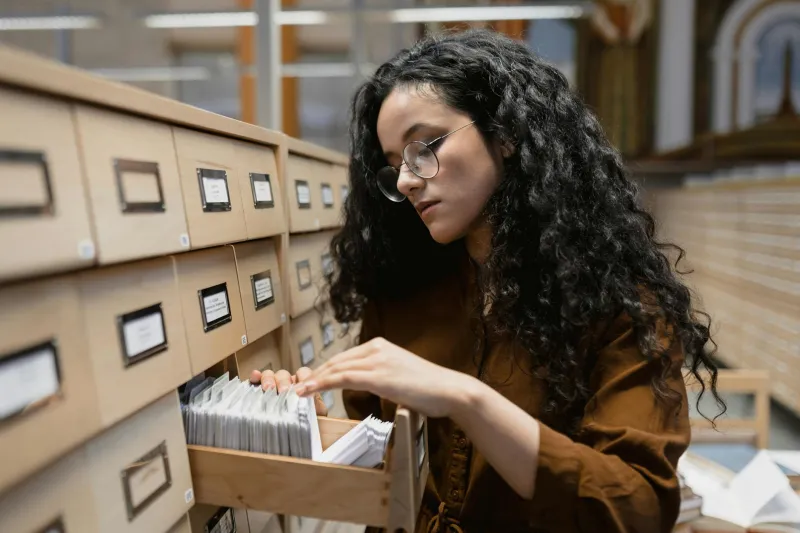
The Accidental Economics Lab
Mildred Patterson never intended to revolutionize American finance. She just wanted people to stop asking her for money.
In the spring of 1953, the head librarian of Clearwater, Kansas—population 2,847—found herself in an uncomfortable position. Patrons weren't just checking out books anymore. They were checking in with sob stories about overdue bills, predatory lenders, and the endless cycle of borrowing that kept families trapped in financial quicksand.
"I'm a librarian, not a bank," Patterson would tell friends. But watching the same faces return week after week, defeated by rejection letters and impossible interest rates, she couldn't shake the feeling that traditional lending was fundamentally broken.
So she did what librarians do best: she started taking notes.
The Research Nobody Asked For
Using the same methodical approach she applied to cataloging books, Patterson began documenting every financial conversation that crossed her circulation desk. Who needed money? For what? How much? What happened when they went to the bank?
Her findings, scribbled in composition notebooks during quiet afternoon shifts, painted a troubling picture. The town's single bank routinely rejected small loan applications—anything under $500 was considered "not worth the paperwork." Meanwhile, traveling loan sharks circled the community like vultures, offering quick cash at rates that would make modern payday lenders blush.
"She turned the library into an unofficial economic survey," recalled Janet Morrison, Patterson's assistant from 1954 to 1958. "People trusted her. They'd tell her things they wouldn't tell their own families."
By 1955, Patterson had identified a clear pattern: most residents needed small amounts of money for predictable expenses—car repairs, medical bills, seasonal gaps in farm income. The amounts were modest, the purposes legitimate, and the borrowers had steady, if unremarkable, sources of income.
The problem wasn't creditworthiness. It was scale.
The Notebook That Banks Ignored
Patterson's solution was elegantly simple. Instead of one large institution making big loans to profitable customers, why not create a network of small loans backed by community knowledge?
She outlined her system in a 47-page handwritten proposal that read like a cross between a library science thesis and a neighborhood watch manual. Borrowers would be vouched for by local references—not just employers, but people who actually knew their character. Loan amounts would be capped at what someone could realistically repay from normal income. Most importantly, the decision-making would happen locally, by people who understood the borrower's circumstances.
"It wasn't rocket science," Patterson wrote in her journal. "It was library science applied to money."
She presented her idea to Clearwater's bank president in the fall of 1955. He listened politely, thanked her for her "community spirit," and suggested she stick to recommending books.
The Kansas State Banking Association was less polite. When Patterson submitted her proposal to their annual conference, the response was swift and dismissive: "While we appreciate Miss Patterson's civic enthusiasm, banking requires professional expertise and regulatory oversight that library volunteers cannot provide."
The Underground Network
Undeterred, Patterson decided to test her theory without official approval.
Starting with her own savings account, she began making small loans to library patrons—$50 here, $100 there, always documented with the same precision she used for overdue book tracking. She recruited a handful of civic-minded residents to contribute to a informal lending pool, managed through a simple card system that looked suspiciously like a library catalog.
The results were remarkable. Default rates stayed below 3%. Borrowers consistently repaid ahead of schedule. Word spread quietly through the community, and the informal network grew to serve nearly 200 families by 1960.
"Mildred had basically invented credit unions without knowing it," said Dr. James Fletcher, an economics professor who studied Patterson's system decades later. "But she'd also solved problems that formal credit unions struggled with—namely, how to assess character-based risk in small communities."
From Card Catalogs to Capitol Hill
Patterson's careful documentation proved prescient. When federal regulators began examining community lending practices in the 1970s, her notebooks provided a rare glimpse into grassroots financial innovation.
The Community Reinvestment Act of 1977 incorporated several principles that Patterson had outlined twenty years earlier: the importance of local knowledge in lending decisions, the viability of small-dollar loans, and the role of community relationships in assessing creditworthiness.
By the 1980s, microfinance advocates were citing Patterson's work as early evidence that peer-to-peer lending could succeed in American communities. Her emphasis on character-based assessment and community accountability became foundational concepts in community development financial institutions.
The Librarian's Last Laugh
Patterson retired in 1978, having spent her final years watching banks slowly adopt practices she'd pioneered in a Kansas reading room. She never sought credit for her innovations, preferring to let others claim the spotlight while she quietly maintained her lending records with the same meticulous care she'd once reserved for book catalogs.
When she passed away in 1991, her estate included 23 composition notebooks filled with financial observations that would later be donated to the Federal Reserve's community banking archives.
"She proved that the best ideas don't always come from the obvious places," noted banking historian Dr. Sarah Chen. "Sometimes they come from people who just pay attention to what's actually happening in their communities."
Today, as policymakers debate the future of community banking and financial inclusion, Patterson's core insight remains relevant: the most sophisticated lending algorithms can't replace the simple human knowledge of who pays their debts and who doesn't.
She learned that lesson not in business school, but in the quiet moments between checking out books and checking in on neighbors—an odd path that led to ideas worth billions.