The Professor Who Worked Nights
Frank DiMarco never set foot inside Harvard Business School as a student. But for three decades, he conducted the most comprehensive field study of urban logistics that Cambridge had ever seen — one garbage truck at a time.
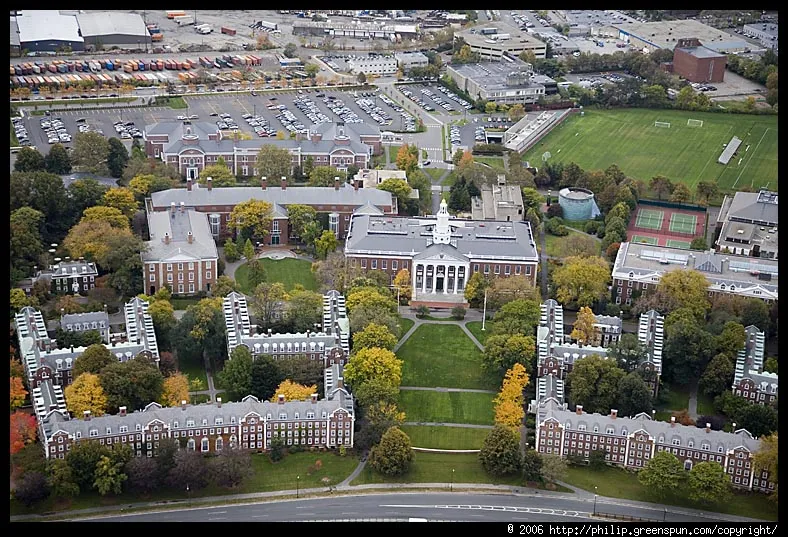 Photo: Harvard Business School, via philip.greenspun.com
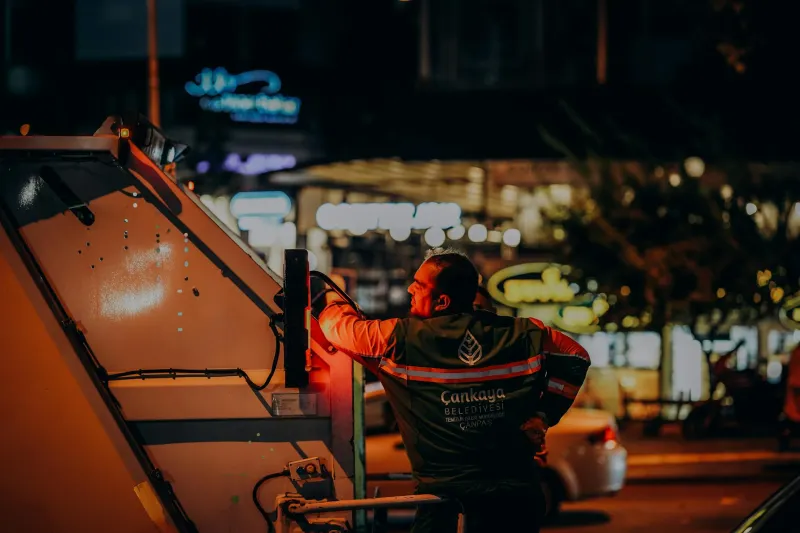
Starting at 4 AM every weekday, DiMarco would pilot his municipal sanitation truck through the narrow streets of Boston's North End, Back Bay, and Beacon Hill. While his colleagues focused on emptying bins and meeting quotas, DiMarco was building something else entirely: a mental map of every inefficiency, bottleneck, and wasted motion in the city's waste management system.
He carried a small notebook in his shirt pocket, jotting down observations during breaks. Why did some routes take twice as long as others with the same number of stops? Why were certain trucks breaking down more frequently? Why did some neighborhoods generate three times more recyclables on Tuesdays than Thursdays?
"Most guys, they see the job as pick up trash, dump trash, repeat," DiMarco would later tell researchers. "I saw patterns everywhere."
The Accidental Scholar
DiMarco's formal education had ended with high school. His father had worked sanitation, and his grandfather before that. It was steady work with good benefits — nothing glamorous, but honest. What his supervisors didn't know was that DiMarco had spent his evenings at the Boston Public Library, reading everything he could find about industrial engineering, operations research, and systems thinking.
By the mid-1980s, his notebook had grown into a filing system. Then boxes of data. Then a spare bedroom converted into what his wife called "Frank's war room" — walls covered with hand-drawn charts tracking pickup times, fuel consumption, equipment failures, and seasonal variations across every route in the city.
His breakthrough came during the blizzard of 1987. While other crews struggled with modified routes and emergency protocols, DiMarco's truck finished its rounds in record time. He had anticipated every problem, mapped every alternative route, and calculated optimal load distributions based on snow accumulation patterns he had been tracking for years.
His supervisor was impressed enough to ask questions. DiMarco's answers were so detailed and systematic that word eventually reached the city's transportation department.
When Harvard Came Calling
Dr. Sarah Chen, a operations research professor at Harvard Business School, first heard about DiMarco through a colleague at MIT who consulted for the city of Boston. She was skeptical. Academic models of municipal logistics were based on sophisticated computer algorithms and theoretical frameworks. What could a garbage collector possibly add to the conversation?
Everything, it turned out.
When Chen finally met DiMarco in 1989, she found herself face-to-face with a man who had solved problems her graduate students couldn't even properly define. His handwritten charts contained insights that would have required millions of dollars in consulting fees to develop through traditional channels.
DiMarco had identified seventeen distinct factors that influenced collection efficiency — from weather patterns to local business cycles to the psychology of how different neighborhoods approached waste sorting. He had developed route optimization strategies that reduced fuel costs by 23% while improving service quality. Most remarkably, he had done it all without a computer, using nothing but observation, intuition, and thirty years of showing up every morning at 4 AM.
The Lesson That Changed Everything
Chen convinced DiMarco to present his findings to her graduate seminar. The response was immediate and humbling. Here was a working-class man with no advanced degree who had developed more sophisticated understanding of complex systems than most of her PhD candidates.
But the real revelation came when Chen asked DiMarco to explain his methodology. His answer revolutionized how Harvard taught operations management:
"You can't understand a system from the outside," DiMarco told the stunned classroom. "You have to be inside it, every day, watching how it actually works instead of how you think it should work. The problems aren't where the experts look — they're in the spaces between the official processes."
The Framework That Stuck
DiMarco's insights became the foundation for what Harvard now calls "Embedded Systems Analysis" — a approach that emphasizes long-term observation from within operational environments rather than external theoretical modeling. The methodology has been applied to everything from supply chain management to healthcare delivery.
The city of Boston implemented DiMarco's recommendations in 1991, reducing operational costs by $3.2 million annually while improving service metrics across every neighborhood. Other cities followed. Today, variations of the "DiMarco Protocol" are used by municipal governments from Seattle to Miami.
DiMarco himself retired in 1995 with a pension and a consulting contract that paid him more in two years than he had earned in the previous ten. Harvard awarded him an honorary degree in 1997.
The Overlooked Genius Next Door
Frank DiMarco's story reveals something uncomfortable about how we think about expertise and innovation. The most transformative insights often come from people who are closest to problems, not furthest from them. The garbage collector who sees the same routes every day notices things that the consultant who flies in for a week will miss.
DiMarco spent three decades being invisible, driving through neighborhoods where residents barely acknowledged his existence. But invisibility, it turned out, was his greatest asset. He could observe systems without changing them, study patterns without bias, and develop solutions based on reality rather than theory.
Today, Harvard Business School requires all first-year students to spend time working alongside frontline employees in the organizations they study. They call it the DiMarco Requirement.
The lesson Frank DiMarco taught America's most elite business school was simple but revolutionary: sometimes the people who know the most about how things actually work are the ones nobody thinks to ask.