The Cemetery Astronomer: How a Gravedigger's Lonely Nights Produced Star Charts Science Couldn't Ignore
The Loneliest Office in America
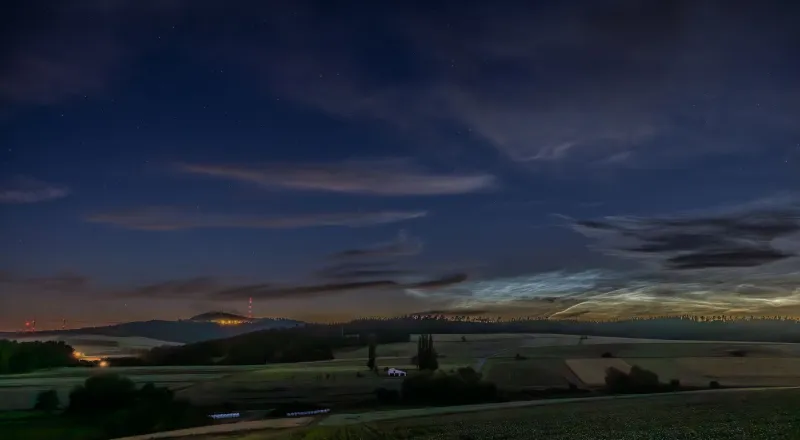
There's a particular kind of quiet that settles over a cemetery after midnight. The groundskeeper knows it better than anyone — the way sound disappears, the way the horizon opens up without city lights pressing in from every direction, the way the sky above a hilltop burial ground feels closer than it does anywhere else.
For most people, that kind of solitude would be unsettling. For Elias Dowd, a laborer who spent the better part of three decades maintaining a rural Ohio cemetery in the mid-1800s, it was the best classroom he ever found.
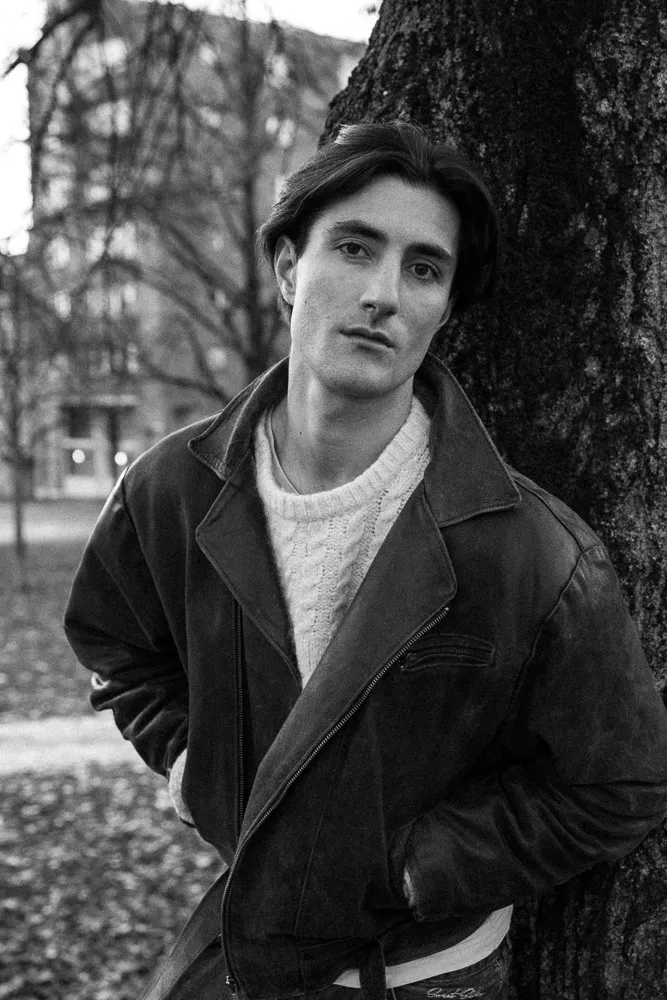 Photo: Elias Dowd, via 3rd.management
Dowd had no university degree. He had no telescope purchased from a catalogue, no correspondence with learned societies, no mentor writing letters of introduction on his behalf. What he had was time, silence, a hand-ground lens he'd assembled from salvaged glass, and an obsession that grew stronger every season he spent alone on that hill.
By the time anyone in the formal scientific community noticed what he'd been doing, Dowd had already charted hundreds of stars with a precision that made professional astronomers deeply uncomfortable — because they couldn't explain how he'd done it.
A Notebook Nobody Asked For
Dowd started keeping records in the mid-1840s, filling composition notebooks with positional observations he cross-referenced against the handful of almanacs and astronomy texts he could borrow from a county lending library thirty miles away. His handwriting was rough. His notation system was entirely his own — invented out of necessity because nobody had taught him the standard one.
That invented system, it turned out, was more efficient than the conventions of the day.
He worked by hand, recalculating positions night after night, correcting for what he called the "drift problem" — the way certain reference points in the published charts he'd borrowed seemed to shift against his own observations over time. He didn't have the vocabulary to call it proper motion. He just knew something was off, and he kept adjusting until it wasn't.
His notebooks stayed in a wooden box under his cot for years. He showed them to almost nobody. The few neighbors who knew about his hobby mostly regarded it the way you'd regard any eccentric's private pastime — with mild amusement and zero urgency.
The Accidental Introduction
The story of how Dowd's work eventually reached the scientific community is almost comically indirect. A traveling Methodist minister who occasionally visited the cemetery for burial services happened to see one of the notebooks left open on a fence post. The minister, who had a passing interest in natural philosophy, recognized that what he was looking at wasn't a hobbyist's scribbles. He wrote a short letter to a colleague at a small college in Pennsylvania.
That colleague visited Dowd the following spring. He spent two days reviewing the notebooks and left visibly shaken.
What Dowd had produced, over roughly fifteen years of solitary observation, was a positional star catalog covering a significant portion of the northern sky — one that corrected errors in several published reference works and identified anomalies that hadn't been formally recorded anywhere. The methodology was unconventional, the notation system was nonstandard, and the man who'd created it had dirt under his fingernails and had never set foot inside a university.
The college colleague wrote a careful, hedged summary of Dowd's findings. He submitted it to a scientific journal under his own name, with a footnote acknowledging "an untrained observer whose raw data proved useful." Dowd was not named.
Borrowed Without Credit
Over the following two decades, elements of Dowd's charting work filtered into the broader astronomical literature in ways that were rarely traceable back to him. His corrected positional data for several star clusters appeared in at least three separately published catalogs, each of which cited the Pennsylvania college summary rather than Dowd directly. His notation innovation — the shorthand he'd invented to track positional drift — was independently "developed" by a university astronomer in Boston about eight years after the minister's visit, and that astronomer received considerable professional recognition for it.
Dowd himself seemed largely unbothered. There's no record of him writing angry letters or seeking public acknowledgment. The notebooks continued. The observations continued. He died in 1887, still working at the cemetery, still filling composition books with data nobody had officially asked him to collect.
A local newspaper ran a brief obituary that mentioned his "amateur interest in the stars." It did not mention the catalogs.
What the Hill Gave Him
It's worth sitting with what actually made Dowd's work possible, because it wasn't talent alone — though he clearly had that in abundance. It was the specific conditions of his life.
The cemetery gave him altitude and darkness, two things professional urban observatories in the mid-1800s were already struggling to preserve as American cities expanded. His working hours gave him uninterrupted access to the night sky at precisely the times when most educated men were asleep. His isolation meant nobody told him which problems were already considered solved, so he kept working on them.
And his lack of formal training meant he had no professional reputation to protect, no peer review anxiety, no institutional pressure to align his findings with the consensus. He just kept writing down what he saw.
There's a version of Elias Dowd's story that gets told as a tragedy — the self-taught genius robbed of credit, the working-class mind ground up by a system that only rewards credentials. That version isn't wrong, exactly. But it's incomplete.
Because the other version is this: a man with a hand-ground lens and a composition notebook spent thirty years looking at the sky from a hilltop in Ohio, and what he found there was real. The stars he charted were in the right places. The corrections he made were correct. The system he invented worked.
Nobody gave him the conditions that made that possible. The solitude, the elevation, the darkness, the hours — those came with the job nobody else wanted. He just decided to use them.
The cemetery didn't hold him back. In a very specific and slightly eerie way, it set him free.