The Dropout Who Decoded the Ocean: How a College Flameout Became America's Most Celebrated Marine Scientist
The Humiliation That Changed Everything
William Beebe sat in the Columbia University registrar's office in 1896, staring at a letter that spelled out his academic doom in precise, unforgiving language. After three years of struggle, the 19-year-old had officially flunked out. His professors found him distracted, unruly, and fundamentally unsuited for serious academic work.
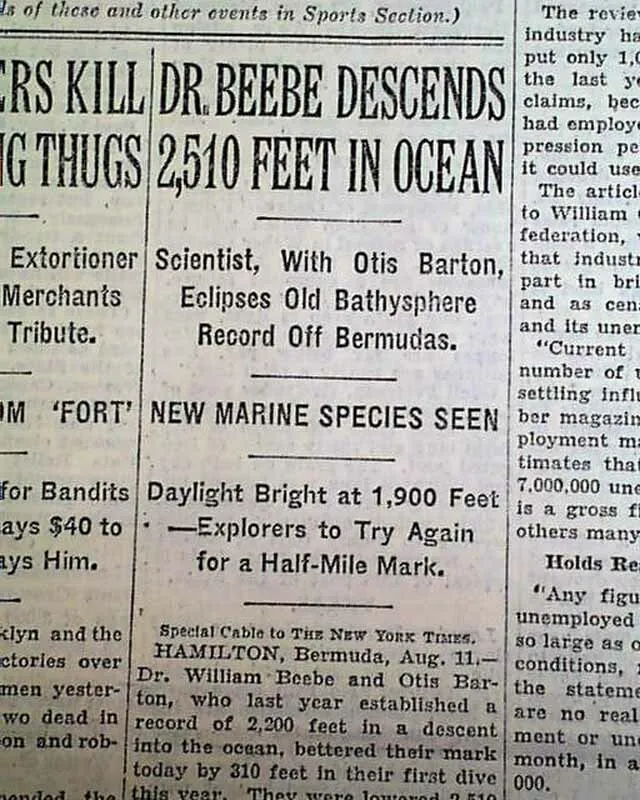 Photo: William Beebe, via i.ebayimg.com
They weren't entirely wrong. Beebe had spent most of his time at Columbia sneaking away from lectures to explore the Hudson River, collecting specimens and sketching wildlife instead of attending to his studies. His dormmates remembered him returning from these expeditions covered in mud, pockets bulging with mysterious specimens, completely oblivious to the homework piling up on his desk.
What those professors couldn't see was that they were witnessing the early stages of one of America's most revolutionary scientific minds at work.
When Failure Becomes Freedom
Most college dropouts in 1896 faced limited prospects. But Beebe's spectacular academic failure freed him to pursue something far more valuable than a degree: direct, hands-on engagement with the natural world that would reshape how Americans understood marine life.
Within months of leaving Columbia, Beebe had talked his way into a position at the New York Zoological Society. His lack of credentials actually worked in his favor—the Society needed someone willing to do the dirty, dangerous work that credentialed scientists often avoided. Beebe threw himself into the role with the same obsessive energy that had derailed his formal education.
While his former classmates sat in lecture halls, Beebe was knee-deep in swamps, scaling cliffs to observe bird behavior, and developing field research techniques that would later become standard practice across the scientific community.
The Ocean Calls an Unlikely Pioneer
By 1920, Beebe had established himself as a respected naturalist, but his greatest discoveries lay ahead. His decision to focus on marine research came from a characteristically unconventional source: pure curiosity about what lay beneath the ocean's surface.
At a time when most marine research involved studying dead specimens dragged up in nets, Beebe insisted on observing sea life in its natural habitat. This approach led him to develop the bathysphere—a revolutionary deep-sea vessel that allowed scientists to descend into ocean depths and observe marine life directly.
The idea seemed insane to most of his contemporaries. The ocean depths were considered unreachable, unknowable, and frankly irrelevant to serious scientific inquiry. But Beebe's willingness to embrace seemingly impossible challenges—the same trait that had made him such a poor student—proved to be his greatest asset.
Diving Into the Unknown
On June 6, 1930, Beebe made his first descent in the bathysphere off the coast of Bermuda. As the steel sphere descended 800 feet below the surface, Beebe became the first human to observe deep-sea creatures in their natural environment.
His radio transmissions from the depths captivated America. Through crackling static, millions of Americans heard Beebe describe a alien world of bioluminescent creatures, bizarre fish adaptations, and ecosystems that defied everything scientists thought they knew about marine life.
"I am writing this at a depth of 800 feet," Beebe radioed to the surface during one dive. "Outside this window, creatures are swimming past that no human being has ever seen alive."
These broadcasts transformed public understanding of ocean life and launched the field of deep-sea marine biology. Beebe's vivid descriptions and fearless exploration captured the American imagination in ways that traditional academic research never could.
The Professor Who Never Was
By 1934, Beebe had descended to 3,028 feet—a record that stood for decades. His discoveries revolutionized marine biology and earned him honorary degrees from the same types of institutions that had once rejected him.
Columbia University, the school that had dismissed him as academically hopeless, eventually awarded him an honorary doctorate. The irony wasn't lost on Beebe, who noted in his journal that he'd learned more about science in a single deep-sea dive than in three years of formal coursework.
His rejection of traditional academic paths allowed him to approach marine science with fresh eyes and innovative methods. While credentialed scientists debated theories in conference rooms, Beebe was developing new research techniques and making discoveries that reshaped entire fields of study.
Lessons from the Deep
Beebe's story illuminates a peculiar truth about American innovation: sometimes the most groundbreaking discoveries come from people who refuse to stay within established boundaries. His academic failure freed him from conventional thinking and allowed him to pursue questions that more traditionally educated scientists might have dismissed as impractical.
His legacy extends far beyond his specific discoveries. The research methods he developed, his emphasis on direct observation, and his ability to communicate scientific wonder to general audiences established templates that marine scientists still follow today.
The college dropout who couldn't sit still in a lecture hall had found his classroom at the bottom of the ocean—and in doing so, he'd opened up entirely new worlds for American science to explore.