The Hometown Nobody Wanted: How One Craftsman's Exile Turned a Dying Tradition Into a Global Obsession
The Craft Nobody Wanted to Save
By the middle of the twentieth century, American folk pottery was dying.
Not disappearing gradually, the way old things tend to fade — dying fast, the way things die when economics turn against them. The regional pottery traditions that had defined communities across Appalachia, the rural South, and the mid-Atlantic for two hundred years were being undercut by mass-produced ceramics from factories in Ohio and New Jersey. Why buy a hand-thrown jug from a local potter when you could get a perfectly uniform one from the hardware store for a fraction of the price?
The potters who remained were mostly old men, working in the same way their fathers and grandfathers had, for a market that was shrinking every year. Their children left for cities. Their techniques went undocumented. Their kilns went cold.
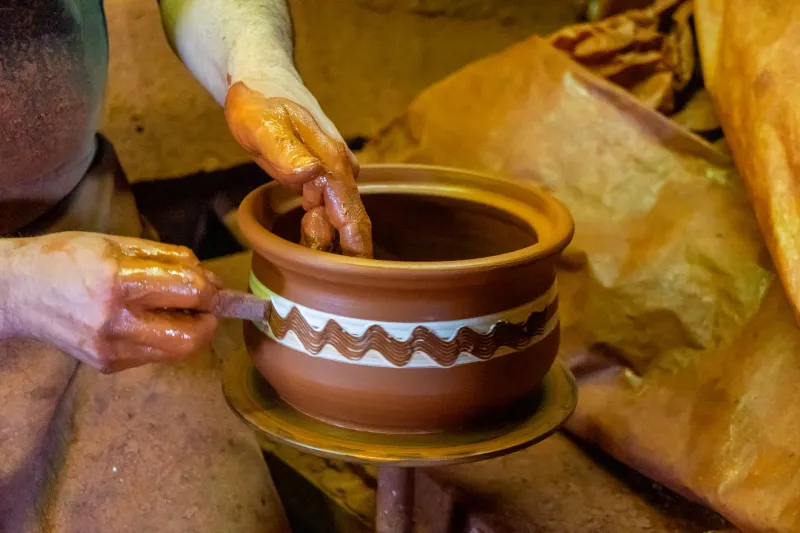
In the North Carolina piedmont, in towns like Seagrove and Jugtown, a handful of families kept the tradition alive through sheer stubbornness. One of them was the Owens family. And one of the Owens family's sons — a young man named Vernon Owens — would spend much of his early life being told, in various polite and impolite ways, that what he did didn't matter.
The Weight of Being Local
There's a particular invisibility that comes with being from somewhere. The things that are ordinary to you — the clay under your feet, the glaze colors you grew up watching, the shapes that your hands have known since childhood — don't register as remarkable. They're just the furniture of your life.
For Vernon Owens, working at Jugtown Pottery in the 1960s and 70s, the tradition he'd been born into felt less like a heritage and more like a limitation. Collectors weren't especially interested. Galleries in Charlotte and Raleigh treated Southern folk pottery as a curiosity at best, a relic at worst. The academic art world had its own hierarchies, and hand-thrown utilitarian ware from rural North Carolina sat near the bottom of them.
This wasn't unusual. Across the country, regional craft traditions faced the same condescension. Navajo weaving, Appalachian basket-making, Louisiana ironwork, New England woodcarving — all of them were being simultaneously romanticized in tourist brochures and ignored by the institutions that determined what counted as serious art.
The people doing the work often internalized the verdict. What they made was useful, maybe charming, but not important. Not worth preserving. Not worth teaching.
Distance Changes Everything
The story of how American folk craft found its audience is, in many ways, a story about displacement.
The craft revival of the late 1960s and 70s didn't start in the communities where the traditions lived. It started in cities — in New York loft studios, in San Francisco galleries, in the workshops of art schools where young people who had grown up with no connection to these traditions encountered them fresh, without the weight of familiarity, and saw something the locals had stopped seeing.
The American Craft Council, founded in 1943 by Aileen Osborn Webb, spent decades doing the institutional work of arguing that handmade objects had artistic and cultural value. But the real tipping point came when the counterculture generation — disillusioned with mass production, drawn to authenticity, hungry for connection to something older and more rooted — started seeking out craft not as nostalgia but as resistance.
Suddenly, the old Southern pottery jugs that nobody in Seagrove had thought to photograph were showing up in Manhattan gallery shows. The salt-glazed stoneware that Appalachian families had used to store food was appearing in coffee table books. The techniques that aging potters had been practicing in obscurity were being called "American folk art" by critics who had never visited the communities that produced them.
The irony was sharp: the tradition had to travel before anyone could see it clearly.
What Comes Back
Vernon Owens watched this happen from Jugtown. He kept working — kept throwing pots in the same way his family had for generations, kept firing the same wood-burning kilns, kept using the same local clay. He didn't chase the trend. He didn't reinvent himself for a new market.
What changed was that the market came to him.
By the 1980s and 90s, Jugtown Pottery had become a destination. Collectors drove hours to buy directly from the source. Craft schools sent students to apprentice. Museum curators arrived with notebooks. The Smithsonian Institution acquired pieces. The North Carolina governor's mansion displayed his work.
None of this had required Owens to move, to change, or to compromise the tradition he'd inherited. What it required was patience — and the eventual arrival of people who had traveled far enough from their own ordinary world to recognize something extraordinary in his.
The Broader Current
Owens' story runs parallel to dozens of others across American craft history. The quilters of Gee's Bend, Alabama — a small, isolated community whose geometric quilts had been made for generations as purely functional objects — were "discovered" by art world visitors in the late 1990s. Their work toured major American museums. The quilts sold for prices that would have been incomprehensible in the community where they were made.
The ironworkers of Charleston, South Carolina, the woodcarvers of the Ozarks, the lacemakers of New Mexico — again and again, the pattern repeats. A tradition dismissed locally, or simply invisible because it was too familiar, becomes luminous when viewed from a distance.
This isn't simply a story about the art world's taste-making power, though that's part of it. It's about something more fundamental: the way that proximity can blind us to value. The things we grow up with, the skills we inherit, the materials we work with every day — they become invisible precisely because they're ours.
What the Exile Teaches
The craftsmen and women who traveled — who left their home communities and carried their traditions into unfamiliar places — often returned changed, and changed the traditions they'd carried.
They'd seen how the work landed on people who had no context for it. They'd heard the questions strangers asked. They'd watched what made people stop and look. That information, carried back to the source, became something like a mirror — a way of seeing the familiar as if for the first time.
The hometown that hadn't valued them hadn't been wrong, exactly. It had just been too close. Sometimes the odd path out is the only way to understand what you left behind.
And sometimes the thing the world ends up obsessing over is the thing you almost threw away because it felt too ordinary to save.